
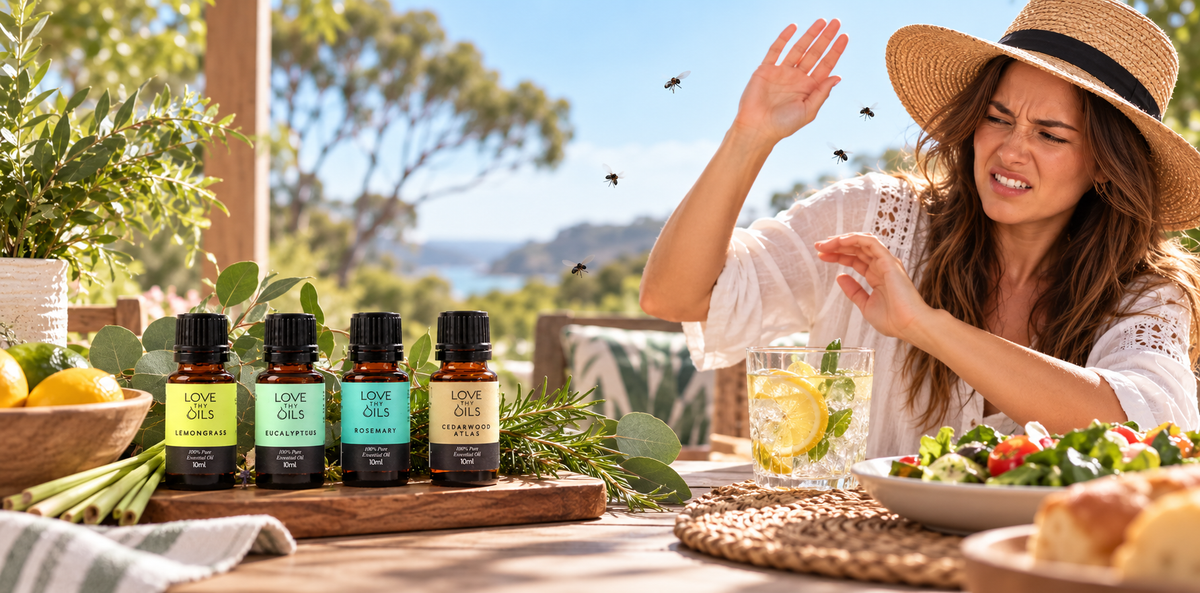

There's a particular sound that means summer has arrived in Australia. Not the cicadas. Not the cricket on the radio.
It's the sound of someone flapping a tea towel over the pavlova.
Flies are the uninvited guest at every Australian barbecue, picnic and open kitchen window from September through to March. And while there's no shortage of aerosols promising to deal with them, a lot of us would rather not spray something over the food, the bench and the children.
The good news is that your oil collection is already doing more than you think. Flies experience the world almost entirely through aroma. They locate food, rubbish and each other using scent receptors on their antennae. A kitchen that smells strongly of peppermint and basil is a kitchen that reads as far less interesting to them.
Here's how to put that to work, with six recipes you can make this afternoon.
Why aroma matters more than you'd think
A housefly's antennae are covered in chemoreceptors that detect volatile compounds from remarkable distances. That overripe banana on your bench is broadcasting a signal, and flies are tuned to receive it.
Strongly aromatic plants have spent millions of years developing volatile compounds that make them less appealing to insects. It's a defence mechanism, and it's the same chemistry we bottle as essential oils. Menthol in peppermint, citral in lemongrass and litsea, eucalyptol in eucalyptus, linalool in basil and lavender.
You're not overpowering the fly. You're making your kitchen a less interesting place to investigate.
The catch: aroma dissipates. Anything you make will need topping up every few days, and more often on hot, windy days when volatiles evaporate faster. That's the honest trade-off for not spraying synthetics around your food.
This only works with real essential oils. A fragrance oil, a "peppermint scented" spray or a candle fragrance is designed to smell like the plant. It isn't extracted from it, and it isn't made to carry the naturally occurring constituents named above. Swapping one in will make your kitchen smell minty, but the chemistry these recipes rely on simply isn't there. Look for the botanical name on the label, such as Mentha piperita for peppermint, and the words "100% pure essential oil".
The oils flies tend to keep away from
These are the ones we reach for most often, and the ones that appear again and again in traditional household practice.
The mints Peppermint and Spearmint are the classics. Sharp, cooling and unmistakable, and the aroma most consistently associated with keeping insects at bay in kitchens.
The herbs Basil is the quiet achiever here, and there's a reason your grandmother kept a basil plant on the windowsill. Rosemary and Thyme work beautifully alongside it, and all three smell like cooking rather than cleaning.
The lemony ones Lemongrass, Litsea (May Chang) and Citronella are all rich in citral: bright, clean and long associated with outdoor entertaining.
The Australian natives This is where we're spoiled. Lemon Myrtle has one of the highest natural citral contents of any plant on earth. Eucalyptus, Rosalina, Niaouli and Tea Tree all bring that clean, medicinal freshness. Our Native Blend brings several of them together in one bottle.
The warm ones Clove Bud and Cedarwood Atlas are the heavyweights. A little goes a very long way, and they anchor a blend beautifully.
Aromatherapist's note: don't use all of them at once. Three or four oils in a blend is plenty. Beyond that you get muddle rather than complexity, and you'll go through your bottles at an alarming rate.
Six DIY recipes
1. The Kitchen Bench Spray
The one you'll make most often. Light, fresh, and it smells like a clean house rather than a chemist.
You'll need:
- 100ml spray bottle
- 80ml water (boiled and cooled, or distilled)
- 20ml witch hazel or plain white vinegar
- 10 drops Peppermint
- 8 drops Basil
- 6 drops Lemon Myrtle
Method: Add the oils to the witch hazel first and swirl, because oil and water don't mix, and the witch hazel helps disperse them. Top up with water. Shake before every use.
Where to use it: Wipe down benches, spritz around the fruit bowl and the bin lid, and mist window sills in the morning. Avoid spraying directly onto food, and test on stone or timber surfaces first.
2. The Back Deck Diffuser Blend
For outdoor entertaining, when you want the table to smell like summer rather than citronella candles.
In your diffuser, add:
- 3 drops Lemongrass
- 2 drops Eucalyptus
- 2 drops Rosemary
- 1 drop Cedarwood Atlas
A cordless diffuser earns its keep here, with no cable running out to the deck. Set it upwind of the table so the aroma drifts across rather than sitting in one spot.
3. The Doorway & Window Wipe
Flies come in somewhere. This treats the entry points rather than chasing them around the kitchen.
You'll need:
- 200ml warm water
- 1 tablespoon white vinegar
- 12 drops Litsea (May Chang)
- 8 drops Peppermint
Method: Combine in a bucket, wring out a cloth, and wipe down door frames, window frames, flyscreens and the sill. Redo weekly through the warmer months.
Why it works: you're creating an aromatic threshold at the point of entry, which is much more efficient than treating the whole room.
4. The Bin & Compost Refresh
The single highest-impact thing on this list, because the bin is usually the reason they're there.
You'll need:
- A handful of cotton pads or diffusing pads
- 5 drops Clove Bud
- 5 drops Lemongrass
Method: Add the oils to a pad and tape it inside the bin lid, or tuck it under the bin liner. Replace every few days. Do the same for the wheelie bin, the nappy bin and the compost caddy.
Bonus: a few drops of Tea Tree in the water when you rinse out the wheelie bin makes the whole job considerably more pleasant.
5. The Gardener's Roll-On
For pottering outside, hanging washing, or eating lunch on the back step.
You'll need:
- A 10ml amber glass roller bottle
- 9ml Fractionated Coconut Oil or Sweet Almond Oil
- 4 drops Lemon Myrtle
- 3 drops Lavender
- 3 drops Rosalina
Method: Add oils to the roller bottle, top with carrier oil, cap and roll between your palms. That's roughly a 2% dilution, gentle enough for regular use on adult skin.
Apply to: wrists, the back of the neck, ankles, and the brim of your hat. Patch test on your inner arm first and reapply as the aroma fades.
6. The Old Terracotta Trick
The one our grandmothers used, and still the most elegant.
Take a small unglazed terracotta pot, saucer or a few clay beads. Add 6–8 drops of your chosen oil and set it on the windowsill, the outdoor table, or beside the fruit bowl. The porous clay holds the aroma and releases it slowly over several days.
Lava stone diffuser jewellery works on exactly the same principle, which is why a drop of peppermint on your bracelet before you head into the garden is such a useful habit.
The unglamorous half of the job
No amount of aroma will out-compete an actual food source. If flies are persistent, one of these is usually why:
- Fruit left out. Especially anything past its best. The fruit bowl is a beacon.
- The bin. Particularly the lid seal and the space underneath the liner.
- Pet bowls and bedding. Rinse bowls daily through summer.
- Standing water. Saucers under pot plants, forgotten buckets, the dog's water bowl.
- Drains. A neglected kitchen or laundry drain is a breeding site.
- Flyscreens with gaps. Worth ten minutes with a torch on a summer evening.
Aroma is the finishing touch on a clean kitchen, not a substitute for one.
Safety first: please read this bit
Cats. This matters more than anything else on this page. Cats lack a liver enzyme needed to process certain compounds in essential oils, and tea tree, eucalyptus, peppermint, citrus and pine are all poorly tolerated. If you have a cat, diffuse only in well-ventilated rooms the cat can freely leave, never apply oils to their fur or bedding, and keep sprays off surfaces they walk on. When in doubt, ask your vet.
Dogs and birds. Dogs are more tolerant than cats but still sensitive, so always give them the option to leave the room. Birds have extremely delicate respiratory systems; we'd avoid diffusing near them altogether.
Children. Keep peppermint and eucalyptus away from the faces of children under three. Use half the dilution for older children, and store all bottles well out of reach.
Skin. Always dilute before applying. Patch test on the inner arm and wait 24 hours. Citrus oils, including lemongrass and lemon myrtle, can increase sun sensitivity, so avoid direct sunlight on freshly applied skin.
Surfaces. Undiluted oils can mark plastics, sealed timber and painted finishes. Always test somewhere inconspicuous.
Pregnancy and existing conditions. If you're pregnant, breastfeeding, or under medical care, check with your healthcare practitioner first.
Frequently asked questions
Which essential oil is best for keeping flies away?
Peppermint is the most popular starting point. It's sharp, long-lasting and pleasant indoors. Basil, lemongrass, eucalyptus and lemon myrtle are the other four we'd reach for. Most people find a blend of three works better than any single oil.
How often do I need to reapply?
Sprays and wipes need refreshing every two to three days, and more often in hot or windy weather. Terracotta and clay hold their aroma for around a week. Diffusers work only while running.
Can I use these recipes around food?
Wipe benches and spray around the kitchen, but don't apply directly to food or to surfaces where food sits uncovered. Let sprayed surfaces dry before use.
Can I use a peppermint fragrance oil instead? It's cheaper.
It's cheaper because it's a different product. A fragrance oil is created in a laboratory to smell like peppermint. An essential oil is extracted from the peppermint plant itself, which is why it carries menthol and the plant's other naturally occurring constituents. Everything on this page depends on those constituents, so a fragrance oil will scent the room pleasantly enough but it isn't doing the same job. The same goes for scented candles, reed diffuser refills and "peppermint fresh" cleaning sprays.
How do I tell an essential oil from a fragrance oil?
Check the label for the botanical name, such as Lavandula angustifolia for lavender or Mentha piperita for peppermint. A genuine essential oil will name the plant it came from. Words like "fragrance", "parfum", "perfume oil", "nature identical" or "aroma oil", or a label with no botanical name at all, all point to something synthetic. Price is a useful clue too: an oil that costs the same whether it's lavender or rose almost certainly isn't either.
Do these recipes work on mosquitoes too?
Mosquitoes respond to different cues than flies, largely carbon dioxide and body heat. If you need genuine protection from mosquitoes, particularly where mosquito-borne illness is a concern, use a product registered with the APVMA for that purpose.
Are essential oils safe around pets?
Not universally, and cats especially. Read the safety section above, and speak to your vet if you're unsure.
What's the best oil to start with if I'm only buying one?
Peppermint. It's the most versatile of the group, it's useful all over the house, and it's an oil you'll keep reaching for long after fly season.
Building your fly-season kit
If you're starting from scratch, the six we'd choose are Peppermint, Basil, Lemongrass, Eucalyptus, Lemon Myrtle and Cedarwood Atlas, which is enough to make every recipe on this page with room to experiment.
You'll find all six in our range of pure essential oils. Add a set of amber roller bottles and a carrier oil and you're set for the season.
Prefer to work with blends? Our Pick Any 6 box lets you choose any six of our signature blends for $89. For summer, we'd reach for Native, Cleanse and Fresh.
Made something you love? Tag us @lovethyoils.aus. We always want to see.
Disclaimer
The information in this article is provided for general information and educational purposes only. It reflects traditional and household use of essential oils and is not intended as professional, medical, veterinary or pest control advice, and should not be relied upon as such.
Love Thy Oils products are supplied as pure essential oils for aromatic and general household use. They are not registered with the Australian Pesticides and Veterinary Medicines Authority (APVMA) as insect repellents or insecticides, and are not sold or supplied for that purpose. Where genuine insect protection is required, particularly in areas where insect-borne illness is a risk, please use a product registered with the APVMA for that use.
The recipes and suggestions in this article are shared for educational and general interest purposes only. They describe traditional and household practices, and they have not been clinically or scientifically tested by us. We make no representation, warranty or guarantee that any recipe will produce any particular result, and results will vary between households, conditions and individuals.
Any recipes described here are prepared and used entirely at your own discretion and risk. Always patch test before applying anything to skin, and test any spray or wipe on an inconspicuous area of the surface first. Keep essential oils out of reach of children and animals. Individual sensitivities to essential oils vary, and an oil that suits one person may not suit another. Consult your healthcare practitioner if you are pregnant, breastfeeding, or under medical care, and speak with your veterinarian if you have any concerns about animals in your household.
Nothing in this article is intended to be, or should be relied upon as, professional advice of any kind: medical, veterinary, pest control or otherwise. It is not a substitute for advice from a qualified professional who knows your circumstances.
To the extent permitted by law, Love Thy Oils accepts no liability for any loss, damage or injury arising from reliance on the information in this article or from the preparation or use of any recipe described in it. Nothing in this disclaimer excludes any rights you have under the Australian Consumer Law.
Share:
Love Thy Oils & Thyself: The Ultimate Self-Care Rituals with Essential Oils
7 Essential Oil Myths We Think It’s Time to Clear Up